
At Advanced Women’s Health of NJ, we know that hearing the word “surgery” can bring up a lot of questions. One of the most common is simple:
What is the difference between open surgery, traditional laparoscopy, and da Vinci robotic-assisted surgery?
We believe women deserve clear, factual information when surgery is part of the conversation. Understanding how these approaches compare can make the options feel more approachable and help you feel more prepared to talk through what may be right for your situation.
Below is a straightforward comparison of three approaches often discussed in pelvic and gynecologic care:
Side-by-side comparison
| Feature | Open Surgery | Traditional Laparoscopy | da Vinci Surgery |
|---|---|---|---|
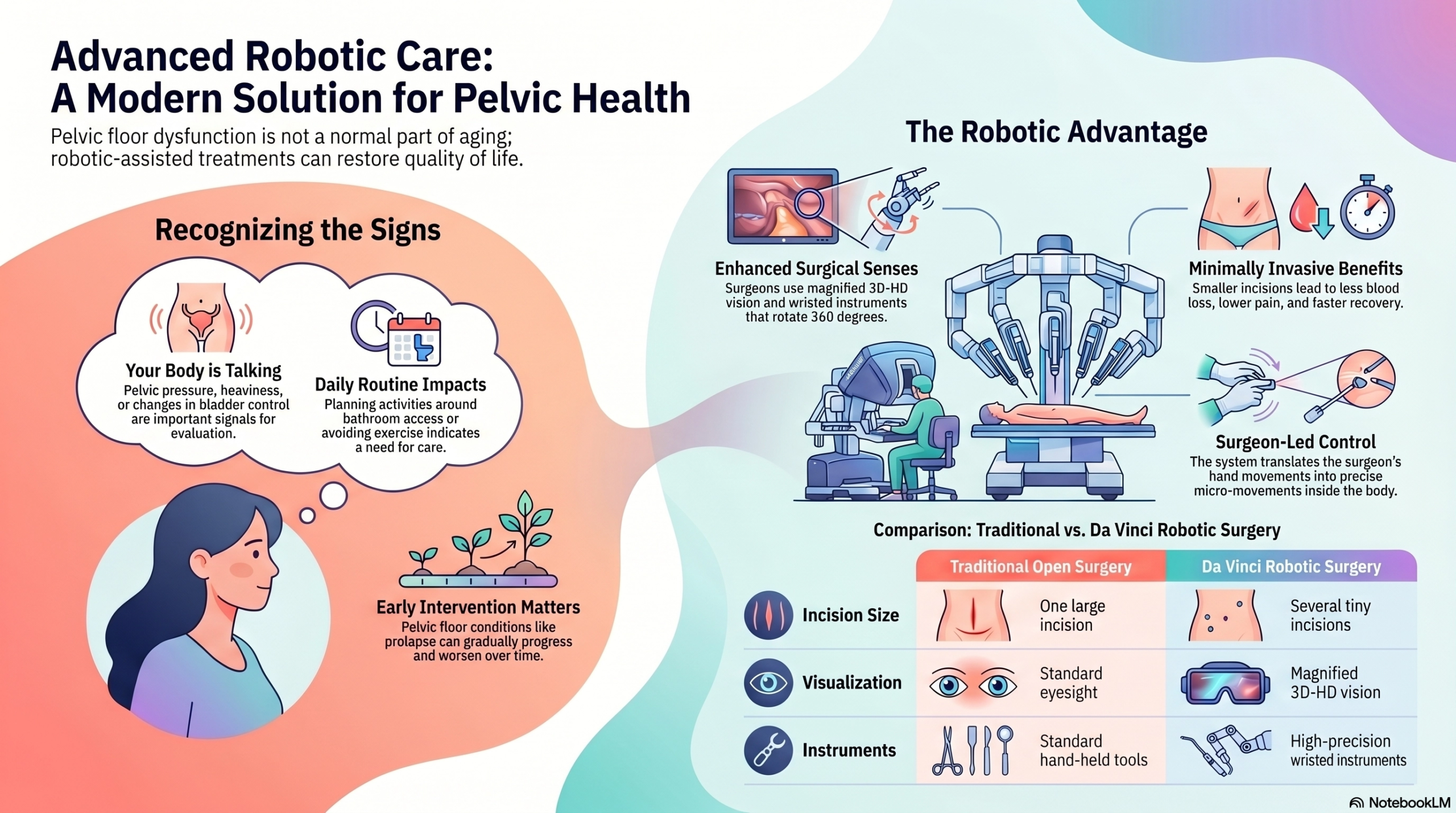
| Incision Size | One large incision | Small incisions | Small incisions |
| Visualization | Direct view | 2D flat monitor | Magnified 3DHD |
| Instrument Movement | Hand-held | Hand-held rigid tools | Robotic-assisted wristed tools |
| Recovery | Longer | Faster than open | Generally faster with less pain |
What these differences mean
Incision size
- Open surgery uses one large incision.
- Traditional laparoscopy and da Vinci surgery both use small incisions as part of a minimally invasive approach.
For many patients, incision size is one of the first differences that feels concrete. Minimally invasive techniques are designed to treat pelvic floor and gynecologic conditions through targeted approaches, rather than one large open incision.
Visualization: how the surgeon sees
- Open surgery gives the surgeon a direct view of the operative field.
- Traditional laparoscopy uses a flat video monitor, which provides a 2D view.
- da Vinci surgery provides a crystal-clear, magnified 3DHD view of the anatomy. That enhanced depth perception is especially important in the pelvis, where the surgical space is confined and delicate dissection may be required.
In other words, the difference is not only about tools, but also about how clearly and deeply the surgeon can see the structures being treated.
Instrument movement: how the surgeon works
- Open surgery uses standard hand-held instruments.
- Traditional laparoscopy uses hand-held rigid tools.
- da Vinci surgery uses robotic-assisted wristed tools. The da Vinci system is a robotic-assisted, minimally invasive platform designed to enhance surgical precision. It translates a surgeon’s hand movements into micro-movements of tiny instruments inside the body.
Those wristed instruments can rotate 360 degrees and provide a range of motion greater than the human hand or traditional rigid laparoscopic tools. The surgeon remains in control throughout the procedure from the surgeon console while viewing a magnified 3DHD image.
Recovery
Recovery is another key difference patients ask about:
- Open surgery: longer recovery
- Traditional laparoscopy: faster recovery than open surgery
- da Vinci surgery: generally faster recovery with less pain
Of course, every patient’s recovery depends on the procedure performed, overall health, and individual circumstances. This comparison reflects general differences among approaches, not a guarantee of any specific outcome.
What this means for patients
At Advanced Women’s Health of NJ, comparing surgical approaches is about clarity. Minimally invasive techniques, including traditional laparoscopy and da Vinci robotic-assisted surgery, typically involve:
- smaller incisions
- less discomfort after the procedure
- a smoother recovery compared with traditional open surgery
That said, not every patient needs surgery, and not every surgical situation calls for the same technique. The right approach depends on each patient’s specific characteristics and condition.
Our role is to help you understand:
- what is happening
- what options may be available
- what an individualized plan could look like
When a conversation may help
If you are weighing surgical options or simply trying to understand what terms like “laparoscopic” or “robotic-assisted” mean, a consultation can provide clarity.
A visit focuses on your symptoms, how they affect daily life, and whether further evaluation or treatment may be appropriate. Many women come in simply wanting better information before making any next step.
At Advanced Women’s Health of NJ, the right approach depends on each patient’s specific characteristics and condition. Not every patient needs surgery, and not every surgical situation calls for the same technique. Our goal is to help you understand the options and create an individualized plan with clarity.
If you have questions about surgical approaches or whether a specialist evaluation is right for you, we welcome you to schedule a consultation.
Locations
- Sparta: 70 Sparta Ave, Suite 209, Sparta, NJ 07871
- Wayne: 1777 Hamburg Turnpike, Suite 202, Wayne, NJ 07470
Appointments: (973) 512-3222
Important Safety Information
Serious complications may occur in any surgery, including injury to tissues/organs, bleeding, or infection. Risks of minimally invasive surgery include longer operative time or the need to convert to an open approach. Patients should consult with their doctor to determine if robotic surgery is appropriate for their specific characteristics and condition.