
At Advanced Women’s Health of NJ, we believe patients deserve clear explanations, not just of whether a procedure may help, but of how the technology works when robotic-assisted surgery is part of the conversation.
The da Vinci Surgical System is a robotic-assisted, minimally invasive platform designed to facilitate surgery by providing the surgeon with enhanced visualization, dexterity, and precision. It translates a surgeon’s hand movements into micro-movements of tiny instruments inside the body, allowing the surgeon to perform a variety of complex urogynecologic procedures with enhanced visualization and instrument control.
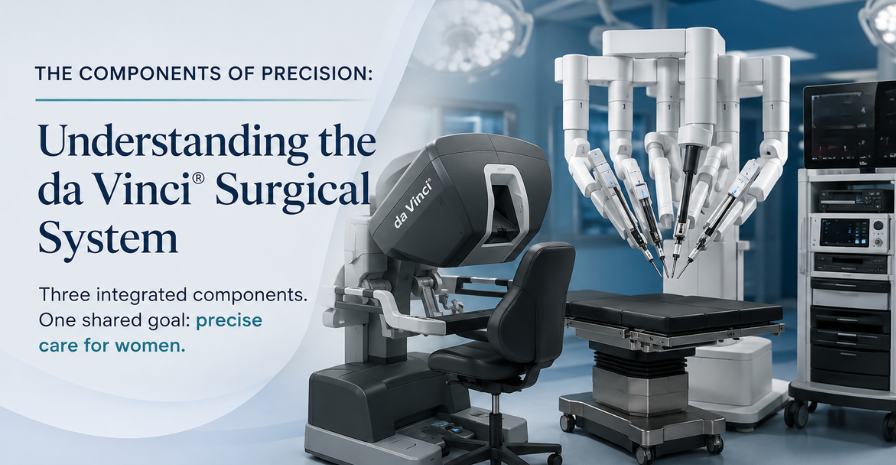
The system is made up of three main components. Understanding each one can make the technology feel less abstract and more approachable.
1. The Surgeon Console
This is where the surgeon sits during the procedure.
From the console, the surgeon controls the instruments while viewing a high-definition, magnified 3D image. The surgeon remains in full control of the operation at all times. The system does not operate independently. It responds only to the surgeon’s movements.
2. The Patient Cart
The patient cart is positioned at the bedside.
It holds the camera and the system’s wristed instruments. These instruments work inside the body through small incisions as part of a minimally invasive approach.
3. The Vision Tower
The vision tower supports the surgical team’s view of the procedure.
It processes the high-definition 3D images and provides a display for the wider care team, allowing everyone involved to follow the procedure as it progresses.
Together, these three components form a coordinated platform: the surgeon directs the operation from the console, the patient cart holds the camera and instruments at the bedside, and the vision tower processes the high-definition 3D images for the care team.
At Advanced Women’s Health NJ, our goal is to help women understand their options with clarity and confidence. If you have questions about robotic-assisted surgery or whether it may be appropriate for your situation, we welcome you to schedule a consultation.
Important Safety Information
Serious complications may occur in any surgery, including injury to tissues or organs, bleeding, or infection. Risks of minimally invasive surgery include longer operative time or the need to convert to an open approach. Patients should consult with their doctor to determine whether robotic-assisted surgery is appropriate for their individual condition and medical needs.